Students in Gabtoli, Dhaka face increasing heat stress inside crowded classrooms, affecting their health, concentration, and ability to learn. This is the second of the “Voices from the Frontline (Phase IV)” stories by ICCCAD, supported by the Climate Ambition Support Alliance (CASA) / DAI Global.Edited by Nusrat Naushin, Chowdhury Abrar Zahin, Mazadul Haque Bayzid and Sumaiya Binte Selim Sudha.
While the streets of Dhaka hum with the sound of private cars and aging buses, a different kind of struggle unfolds behind the vibrant aquatic murals of a small school in Gabtoli. Despite the “beautiful” sunny weather outside, the reality for students within these walls is a grueling battle against an invisible enemy: urban heat stress. In a city where temperatures are projected to exceed 35°C with increasing frequency through 2035, the classroom is becoming a frontline for climate vulnerability.
The Heat Trap: Why Fans Aren’t Enough
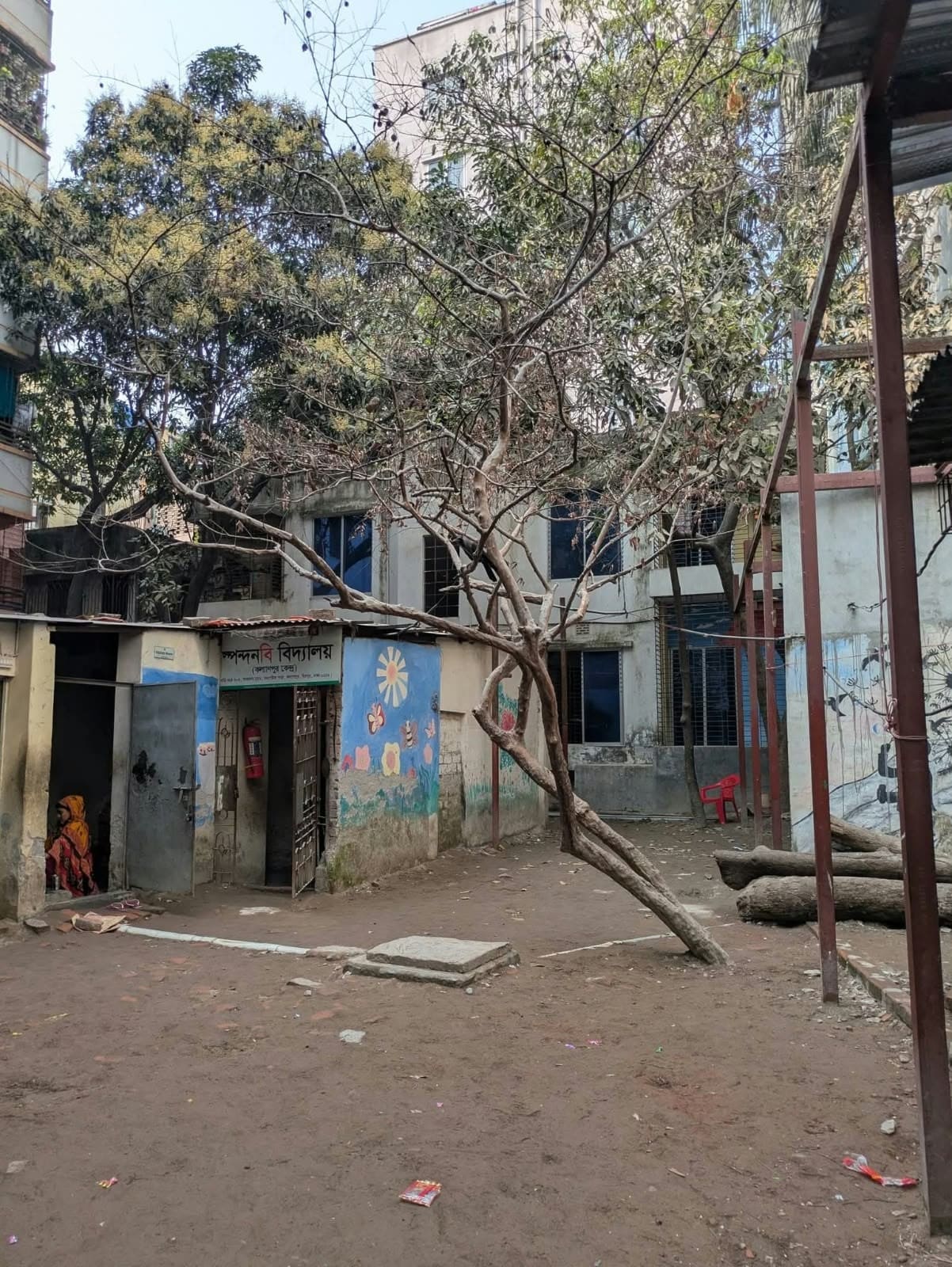
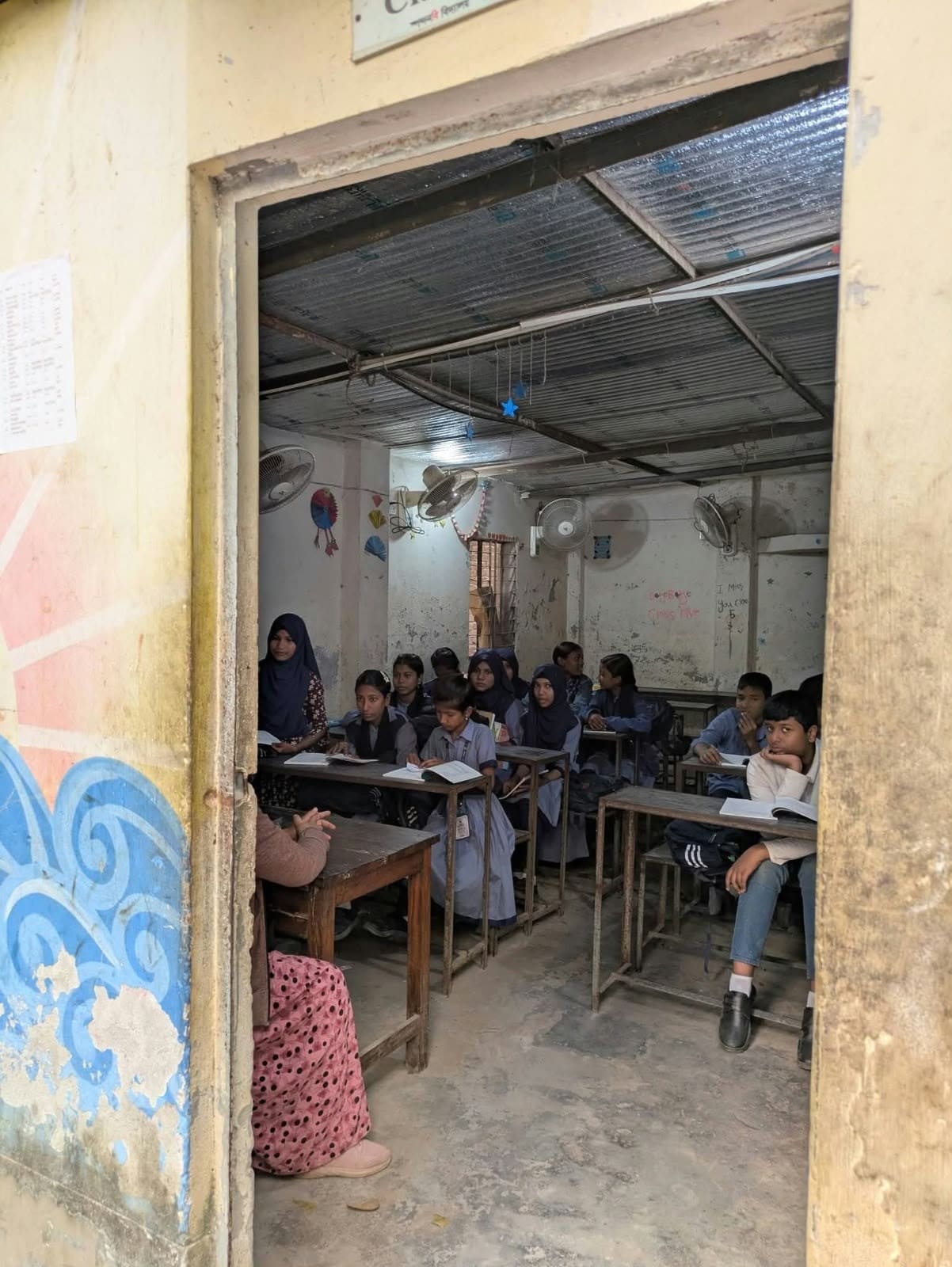
The school’s architecture—one-storied classrooms surrounding a concrete courtyard—is a manifestation of the Urban Heat Island (UHI) effect that plagues Dhaka. Inside, students like Arsha (Class 8), Shohan (Class 9), and Mostofa (Class 9) describe a “sweltering” environment where the small classrooms effectively trap heat. Mostofa feels particularly uneasy due to the intense humidity, while Shohan notes that frequent power cuts (load-shedding) during summer months make it impossible to focus on lessons.
Their teacher, Mr. Proshanta, explains that the physical limitations of the building exacerbate the problem; the rooms are tiny, and with no ventilation paths other than a single door, adding more fans offers little relief. This mirrors findings in wider studies of Dhaka, where metropolitan areas can be up to 3°C warmer than their outskirts due to a lack of green space and the concentration of heat-retaining materials like concrete.
A Toll on Health and Learning
The impact of this heat is not merely a matter of discomfort; it is a significant health and educational hazard. The students reported a range of symptoms, including:
- Physical Ailments: Rashes, dehydration, and coughs or colds caused by excessive sweating in high humidity.
- Cognitive Decline: A noted difficulty in concentrating on lessons during peak heat hours.
- Behavioral Shifts: Arsha admitted that her home is actually more comfortable than school because it offers better ventilation and fewer people, a sentiment that highlights how the classroom environment can become a deterrent to attendance.
These local accounts align with national data showing that heat stress leads to significant “competency loss” in subjects like Science and Mathematics, which are the hardest to recover once learning time is lost. Furthermore, the lack of basic resources, such as water filters, means students only drink water about twice a day, further increasing the risk of dehydration and heatstroke.
The Limit of “Reactive” Resilience
The students and staff are not passive; they are already attempting to adapt. Mr. Proshanta has begun planting trees with the children to create a “green” perimeter, and students have suggested rooftop gardens to help regulate the building’s temperature. However, as seen in other climate-stressed regions like Khagrachari, local ingenuity has its limits without structural support.
The students’ requests are simple but vital: more water dispensers, better ventilation, and more ceiling fans. Experts suggest that more advanced “passive cooling” strategies, such as reflective “cool roofs” or green roofs, could lower indoor temperatures by as much as 2°C and recover significant labor and learning hours.
Analysis: A Call for Climate-Smart Schools
Mr. Proshanta reflects on a childhood where, despite a lack of electricity, larger rooms and a wealth of trees made the environment easier to cope with. Today’s students in Gabtoli do not have that luxury. Their experience underscores the intra-urban inequality of climate change; while wealthier residents in areas like Gulshan use air conditioning and modern insulation to escape the heat, students in Gabtoli and residents of slums like Korail are left to fend for themselves in “unbearable” tin and concrete traps.
To honor the resilience of students like Arsha, Shohan, and Mostofa, urban planning in Dhaka must prioritize green infrastructure and climate-sensitive building standards. As Nafisa, a student from a similar study, aptly noted: “When the earth is safe, we are safe”. Without systemic intervention, the rising heat of Dhaka threatens to steal the focus, health, and academic potential of an entire generation.
Interviewee’s Perspective
From the students’ point of view, the classroom is no longer a place of comfort or curiosity during the summer months, but a space to endure. The heat makes their uniforms stick to their skin, their heads feel heavy, and their lessons blur together, especially when the power goes out and the fans stop working. Drinking water is rationed, concentration slips away, and some days it feels easier to stay at home than to sit in a crowded, airless room. Yet alongside frustration, there is also awareness and hope. Students talk about planting trees, dreaming of rooftop gardens, and wishing for simple changes—more water, better airflow, a cooler roof—that could make a real difference. For them, the heat is not just about discomfort; it is about whether they can learn properly and imagine a future where school supports their well-being instead of draining it
Interviewer’s Perspective
The interview felt less like a conversation about infrastructure and more like bearing witness to an unseen crisis, where climate change quietly erodes attention spans, health, and motivation. What stayed with me most was how normalized this struggle had become: children describing headaches, dizziness, and loss of focus as if these were just another part of school life, rather than warning signs of a system under strain.
About The Author: Tahia Tasnim is a Teacher at South Breeze School in Dhaka.