Older people in coastal fishing communities in India face climate-induced loss and damage affecting their livelihoods, health, culture, dignity, and sense of belonging. This is the first of the “Voices from the Frontline (Phase IV)” stories by ICCCAD, supported by the Climate Ambition Support Alliance (CASA) / DAI Global.
A Life Shaped by the Tides
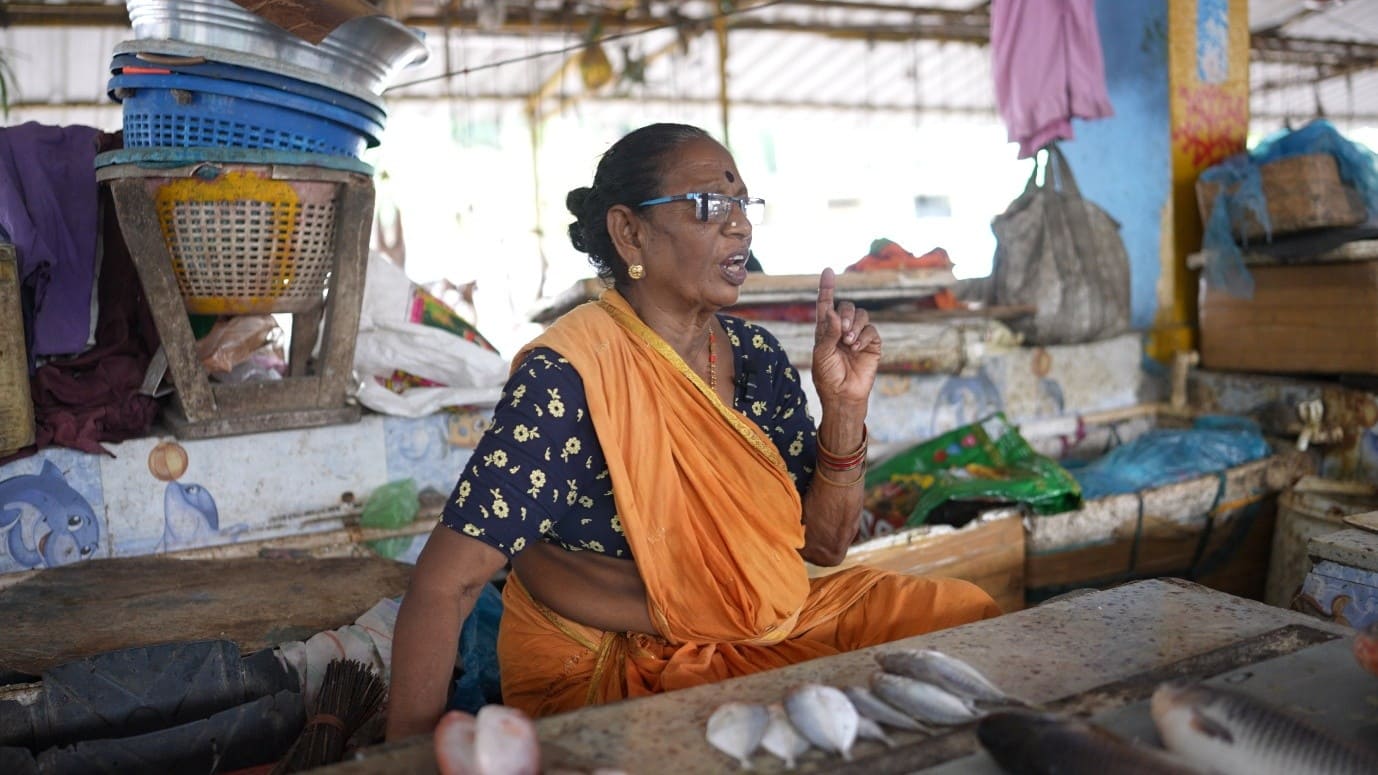
On the east coast of India, in the state of Andhra Pradesh, in the small fishing hamlet of Dibbapalem, a village in Visakhapatnam District, lives Nolli Erramma, a seventy-year-old fisherwoman whose story mirrors the struggles of thousands of older women in small-scale marine fishing communities. For more than four decades, Erramma balanced heavy baskets of fish on her head, walking miles to sell her catch in the city’s markets. Those baskets once held her family’s survival, dignity, and dreams.
Today, she survives on a modest pension and occasional earnings from her widowed daughter’s sales of small fish or vegetables. Her three sons have migrated inland in search of work, leaving her behind on a coast battered by heatwaves, cyclones, and declining fish stocks. The sea that once gave her everything now takes away piece by piece—livelihood, health, and identity.
“The sea raised me, but now it feels like it no longer knows me,”
says Erramma, her eyes tracing the restless horizon. “Each storm takes away something I can never rebuild.”
Invisible Victims of a Visible Crisis
Coastal Andhra Pradesh faces intensifying cyclones, tidal surges, and saline intrusion that devastate small-scale fishing communities. Older women are hit hardest—displaced repeatedly, excluded from entitlements, and burdened with unpaid care and informal fish work. With eroding livelihoods and weak social protection, climate extremes deepen their insecurity, isolation, and lifelong gendered vulnerabilities.
Erramma’s story brings humanity to the abstract debates on Loss and Damage, showing how climate change inflicts irreversible harm that money cannot repair. The cyclone Hudhud that had the landfall in Visakhapatnam district in the year 2014, flattened her home and livelihood, forcing her into endless cycles of debt and unequal recovery where aid bypassed women like her. The other cyclones that made landfall in different districts in the region, such as, Cyclone Asani (2022) and Cyclone Michaung (2023), have also caused considerable damage to the homes and livelihoods of smaller fishing communities in Visakhapatnam. Now, relentless heat makes survival unbearable—afternoons feel like “sitting inside a boiling pot,” nights bring fear of suffocation or snake bites. For older people, this is not discomfort but danger. Yet their suffering and deaths remain unseen, uncounted, and unnamed in the official records of climate policy.
From Abundance to Uncertainty
In her youth, the sea was generous. A basket of fish costing ₹20 could feed a family of five, and the ocean’s bounty gave her dignity, agency, and social respect. Now, she says, even the very character of the water has changed—the smell, colour and overall quality of the seawater are no longer the same. Fish are smaller, scarcer, and often diseased, and declining stocks combined with erratic monsoons have stripped away the reliability that once defined her trade.
“When I was young, I feared hunger only if the nets tore,” she recalls.
“Now, even when the nets are strong, the sea gives us nothing.”
Erramma’s experience captures the intersection of age, gender, and climate vulnerability. As physical strength wanes, economic independence erodes. The loss of livelihood becomes a loss of identity—a non-economic wound seldom recognised in policy frameworks.
Cultural Erosion and Vanishing Traditions
Beyond the loss of homes and livelihoods lies a quieter, deeper erosion—the fading of cultural life that once bound coastal communities together. Festivals honouring Goddess Gangamma, once celebrated with drums, dance, and collective joy, now survive only as faint echoes. The fervour, crowds, and energy have diminished as climate-driven migration pulls young people inland, leaving older women like Erramma to shoulder the remnants of tradition.
Years of relentless labour, lack of pensions, hunger, and the exhaustion of rebuilding after cyclones have drained their stamina and ability to participate. Displacement, damaged houses, and the absence of disposable income make even modest celebrations impossible.
In Erramma’s story, the decline of festivals mirrors the decline of her world—the fraying of social bonds, identity, and collective resilience. These cultural losses, though uncounted in climate finance metrics, represent profound non-economic damage. Rebuilding resilience must therefore protect not only homes and livelihoods, but the cultural heartbeat that sustains older women like her.
The fading of these traditions—so vital to community cohesion and emotional resilience—must be recognised and counted within non-economic Loss and Damage frameworks. Their disappearance reflects not just the loss of celebration but a profound weakening of social strength, identity, and mutual support.
Yet such losses remain overlooked in climate discourse, which still prioritises infrastructure over belonging, and material damage over cultural survival. Strengthening these cultural and social foundations is essential for true climate resilience, especially for older women like Erramma, whose well-being depends as much on community connection as on physical recovery.
Ageing, Gender, and Exclusion from Recovery
Erramma’s story reveals how disaster recovery and adaptation systems routinely fail older women. After Cyclone Hudhud, she received only ₹5,000 and a few cement sheets—nowhere near enough to rebuild her home or her sense of safety. Distribution of disaster relief favoured the vocal, male, and well-connected.
“We cannot fight in queues or argue with officers,” she says softly. “By the time our turn comes, the help is gone.”
As an older woman, her exclusion is compounded. Disaster consultations seldom include women her age, early-warning systems rely on digital alerts she cannot always access, and even self-help groups bar members above 60. For Erramma, this intersection of age and gender results in deep isolation—not only from resources, but from participation, voice, and decision-making itself.
Health as a Measure of Loss
Erramma’s ageing body bears the marks of climate stress—heat worsens her joint pain, humidity triggers infections, and medicines costing ₹4,000 a month exceed her pension, forcing her to choose between food and treatment. This is non-economic loss at its harshest: declining health and dignity without recovery. Public health systems remain unprepared for climate-induced illnesses among older women who laboured for decades without protection. Widowed by a cyclone, her daughter is now her sole caregiver. Together, they survive on care, not capital—a fragile resilience that should compel policymakers to recognise and respond to the human cost of climate change.
The Unseen Geography of Displacement
Migration has become the new rhythm of the coast. Erramma’s sons now work as labourers in other states and seldom return. Like countless fishing families, they have been displaced not by choice but by necessity.
Yet Erramma refuses to leave. Her bond with the land is emotional as much as spiritual—woven through memories, ancestors, and a lifetime beside the sea.
“My faith in Mother Gangamma keeps me here,”
(fishing communities refer to the sea as the holy river Ganga), She says. “Even if life is harsh, I will die where the waves can still hear my name.”
Such rootedness, while poignant, also reveals the immobility trap faced by older people unable to migrate. As younger members depart, social networks thin, leaving the elderly more exposed to shocks and loneliness.
When Resilience Fades
Erramma remembers a time when her community stood united—sharing fish, shelter, and strength after every storm. Today, that solidarity is fading under the weight of climate and economic pressures. As families migrate and informal support systems collapse, older women like Erramma are left behind, facing not only environmental hardship but also profound social isolation. Climate change in her village is no longer just about rising temperatures or storms—it is about the slow erosion of belonging, identity, and collective resilience. This human dimension of loss underscores the urgent need for inclusive, community-driven adaptation and climate finance that values non-economic losses such as dignity, culture, and relationships. Policymakers must recognise these invisible costs and design responses rooted in justice and compassion. Erramma’s plea is simple yet powerful:
“Do not forget the old women of the fishing villages. We carried the sea on our shoulders for decades—do not let us be washed away like broken nets.”
Beyond Numbers: Recognising Human Worth
Erramma’s experience underscores a fundamental truth: climate change is not gender-neutral, age-blind, or socially even. Older women in informal sectors bear the brunt of cascading losses without recognition or redress. Their suffering rarely enters loss-and-damage accounting systems, yet it defines the moral urgency of climate justice.
Non-economic losses—like the fading of festivals, the weakening of community bonds, the erosion of confidence, and the quiet deaths of elders in heatwaves—demand as much attention as economic recovery plans. These losses cannot be insured, rebuilt, or repaid, but they can be acknowledged and prevented through inclusive policy design.
Policy Imperatives from Erramma’s Shore
Climate action must recognise older people—especially older women—as central stakeholders in adaptation, disaster risk reduction, and Loss and Damage financing. Climate policies should integrate age- and gender-responsive social protection, linking pensions, healthcare, and disaster insurance to vulnerability assessments. These measures ensure that those most exposed to climate risks are not sidelined in planning or resource allocation.
Equally important is investing in community-led adaptation that rebuilds cultural and social capital, from festivals and cooperatives to intergenerational knowledge exchange that strengthens identity and belonging. Climate finance must be accessible to last-mile beneficiaries, such as fisherwomen, rather than absorbed by intermediaries. Documenting and valuing non-economic losses—from trauma to cultural erosion—is essential for creating climate accountability systems that are humane, inclusive, and just.
A Testament of Survival and Hope
As the sun sets over Dibbapalem, Nolli Erramma sits beside her cracked wall, listening to the sea’s mournful song. Her life, marked by storms and loss, speaks of justice denied yet dignity reclaimed. In her quiet resilience lies a message for global climate leaders: climate action is incomplete without the wisdom and suffering of women like her. True fairness in Loss and Damage finance must begin on forgotten shores like hers—where older women continue to endure and resist, their names carried in the whispering waves that refuse to let them be erased.
Conclusion and recommendations
Erramma’s story shows how climate change erodes not only homes and livelihoods, but dignity, identity, cultural continuity, and the emotional world of older women in small-scale marine fishing communities. Their exclusion from recovery, adaptation planning, and social protection leaves them invisible within climate policy and Loss and Damage frameworks. To address this, governments and climate actors must integrate age- and gender-responsive measures into National and Local Adaptation Plans and climate finance mechanisms. Strengthening pensions, healthcare, and early-warning access; enabling older women’s participation in decision-making; documenting non-economic losses; and financing community-led, culturally rooted adaptation are essential for ensuring justice for older fisherwomen like Erramma.
About the Interviewee
Nolli Erramma, a seventy-year-old fisherwoman from India’s east coast, embodies the harsh inequities of climate vulnerability and recovery. Repeated cyclones like Aila and Hudhud have trapped her in cycles of loss and debt, while relentless heatwaves and vanishing fish stocks have stripped her of health, dignity, and livelihood. Her experience reveals how older women in fishing communities face irreversible, unrecognised damage from climate change. Erramma’s voice calls for age- and gender-responsive adaptation and Loss & Damage finance, ensuring that the basic needs of survival—food, shelter, medicine, and dignity—are met for those paying the highest price for a crisis they did not create.
About the Interviewer
Hari Krishna Nibanupudi is an international expert on climate change, humanitarian response, and sustainability with over two decades of leadership across Asia and Africa. As Global Climate Change and Ageing Adviser at HelpAge International, he champions the inclusion of older people in climate policy and finance. Formerly with UNDP, WFP, UN-Habitat, ICIMOD, and Oxfam, he has led major initiatives on disaster risk reduction, climate adaptation, and resilience. A mentor for climate innovators through SDSN, MIT Climate CoLab, and the Climate Reality Project, and a member of IUCN’s Climate Crisis Commission, he promotes a rights-based, people-centred approach to resilience.